Amazon Echo Dot vs Google Nest Mini compared across sound quality, Indian English & Hindi voice accuracy, and smart home routines—pick your winner now.
In this article
Deciding between the Amazon Echo Dot vs Google Nest Mini is really a decision about which voice ecosystem will anchor your home for the next five years. On paper, both compact speakers cost less than a mid-range Bluetooth speaker, answer general trivia, set kitchen timers, stream music over dual-band Wi-Fi, and toggle your smart lights and plugs by voice. Yet once you live with them daily, their hardware architectures and software priorities diverge sharply.
In this head-to-head comparison, you will learn how the Echo Dot 5th Gen vs Nest Mini 2nd Gen stack up across acoustic bass response, Indian accent and Hinglish recognition, smart home automation routines, onboard environmental sensors, and festive sale pricing.
Head-to-Head Specs: Echo Dot (5th Gen) vs Google Nest Mini (2nd Gen)
Because Amazon updated the Echo Dot to a spherical acoustic enclosure with a larger driver and onboard sensors while Google kept the Nest Mini in its slim fabric-puck form factor, the hardware gap is wider than ever.
| Model / Option | Best For | Key Verified Specs | Typical Price Range | Key Trade-off | Check Price |
|---|---|---|---|---|---|
| Amazon Echo Dot (5th Generation) | Smart home automation, bedroom music & AC routines | 1.73-inch (44mm) front-firing speakerBuilt-in temperature + ultrasonic motion sensorsDual-band Wi-Fi, BLE Mesh, Matter controller | ₹4,499 – ₹5,499 ($35 – $50) | + Richer bass and clearer vocal separationTemperature & occupancy sensors trigger routinesPhysical action & mic-mute buttons on top − No 3.5mm AUX jack; requires desk spaceHigher MSRP outside festive sales | Check on Amazon |
| Google Nest Mini (2nd Generation) | Wall mounting, YouTube Music & Android TV households | 1.58-inch (40mm) upward-firing driver3 far-field microphones + ultrasonic proximity LEDsBuilt-in rear keyhole wall mount + Chromecast Audio | ₹2,499 – ₹3,999 ($29 – $49) | + Built-in wall mount saves bedside table spaceBest-in-class YouTube Music & Android TV castingStrong bilingual Hindi + English Q&A − Thinner mid-bass at volumes above 70%No temperature sensor for climate routines | Check on Amazon |
| Amazon Echo Pop (1st Generation) | Budget secondary rooms & study desks | 1.95-inch directional front-firing driverSemi-sphere compact chassisMatter controller + eero Mesh Wi-Fi extender | ₹2,999 – ₹3,999 ($25 – $40) | + Frequently drops to ₹2,499 during Amazon salesClear directional audio for small study desks − Lacks the Echo Dot 5th Gen's temperature & motion sensors | Check on Amazon |
Design, Build & Placement Flexibility
Physical placement in Indian bedrooms and kitchens often dictates which speaker fits your room layout better—especially where switchboards sit halfway up the wall or bedside tables are cramped.
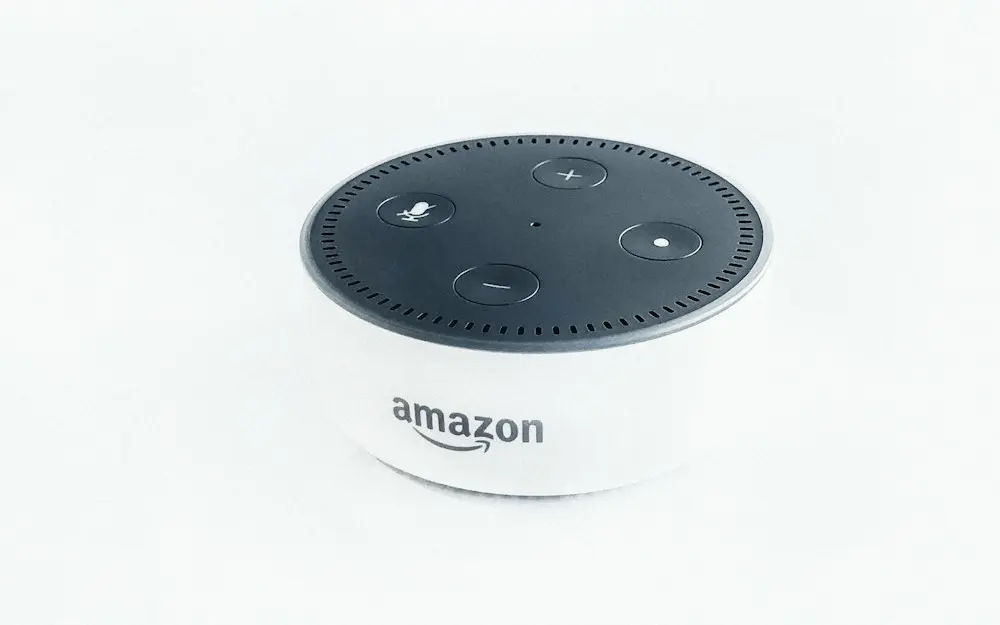
Amazon Echo Dot (5th Gen): Acoustic Sphere with Bottom Glow Ring
Measuring 100 x 100 x 89 mm and weighing 304 grams, the Echo Dot 5th Gen looks like a fabric-wrapped orb with a flattened base. Amazon moved the signature cyan-and-blue LED status ring to the bottom edge so it reflects softly off your tabletop—making it easy to see from across a dark bedroom without shining directly into your eyes. On the top panel sit four tactile physical buttons (Volume +, Volume -, Action, and Microphone Off), plus an accelerometer/capacitive tap zone that lets you tap the top of the sphere to snooze morning alarms or pause music.
However, because of its spherical shape and lack of a rear mounting slot, the Echo Dot requires a flat shelf, study desk, or third-party plastic socket hanger.
Google Nest Mini (2nd Gen): Discreet Wall-Mountable Fabric Puck
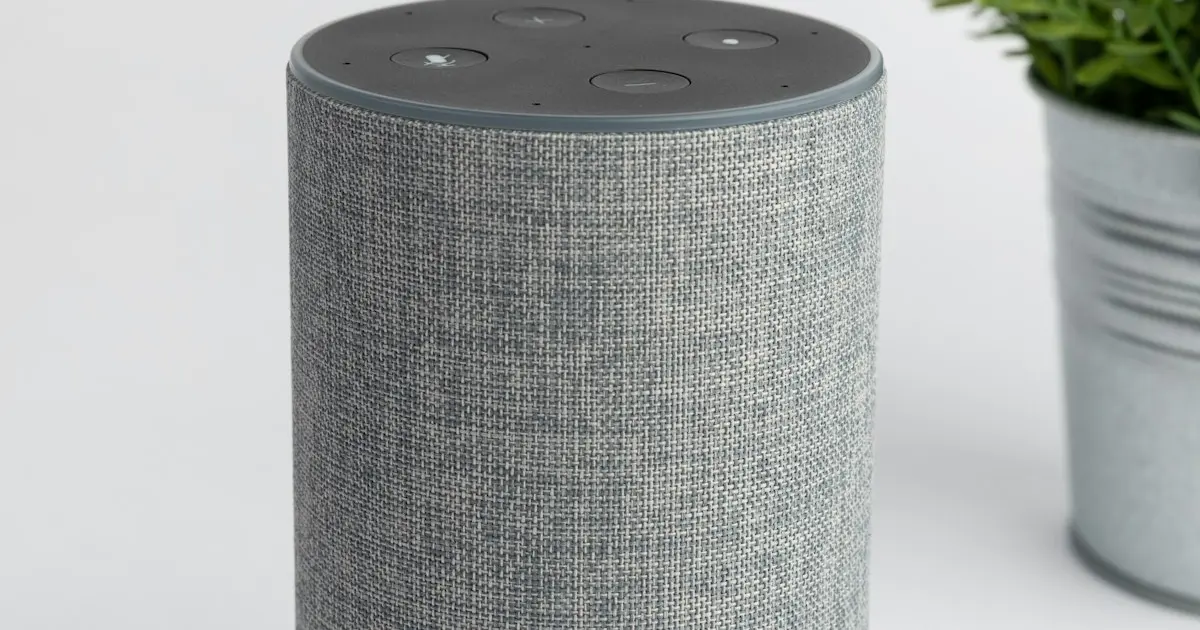
At just 98 mm wide and 42 mm tall (weighing 181 grams), the Google Nest Mini 2nd Gen disappears into room decor far more easily. Its top cover is woven from 100% recycled plastic bottles, concealing four white LED dots that illuminate as your hand approaches to indicate touch zones for play/pause (center) and volume control (left and right flanks).
Crucially, Google molded a keyhole wall-mount slot directly into the underside of the polycarbonate base. With a single drywall screw, you can hang the Nest Mini vertically on a kitchen backsplash or corridor wall right next to a 6A power socket—no third-party brackets required.
Audio Quality & Microphone Array Performance
When evaluating the Echo Dot 5th Gen vs Nest Mini 2nd Gen on pure sound quality, physics favors the larger enclosure.
- Bass & Midrange Fullness: The Echo Dot 5th Gen houses a 1.73-inch (44 mm) front-firing neodymium driver inside a resonant spherical cavity that delivers roughly double the low-end bass punch of older puck-style Echo Dots. Listening to Bollywood tracks, acoustic vocals, or podcasts at 50% to 75% volume feels warm and room-filling in a 12x14 ft bedroom. By contrast, the Google Nest Mini’s 40 mm upward-firing driver sounds crisp and balanced for spoken-word news and vocals up to 60% volume, but compresses noticeably and loses bass weight when pushed above 75%.
- Stereo Pairing & Home Theater Hooks: Two Echo Dot 5th Gen units can be linked in the Alexa app as a left/right stereo pair and bonded wirelessly to a Fire TV Stick 4K for budget home-theater audio. Two Nest Minis can also form a stereo pair for music casting, though if your main goal is upgrading television dialogue, you are much better served by reading our guide on how to choose a soundbar for your smart TV.
- Far-Field Wake-Word Pickup: Both speakers use multi-microphone beam-forming arrays that reliably catch “Alexa” or “Hey Google” over a ceiling fan running at speed 4. In noisy kitchens (such as when a chimney or mixer-grinder is running), the Echo Dot’s four-mic processing and customizable wake words (“Alexa”, “Echo”, “Amazon”, “Computer”) trigger with fewer false negatives than Google’s mandatory two-word “Hey Google” or “OK Google” wake phrase.
Alexa vs Google Assistant Voice Control, Languages & Indian Context
For families where parents, kids, and grandparents all interact with the speaker, Alexa vs Google Assistant voice control comes down to two different strengths: conversational knowledge vs structured device control.
- Multilingual & Hinglish Fluency: Both assistants support English (India), Hindi, and bilingual modes where you can ask one question in Hindi (“Aaj mausam kaisa hai?”) and the next in English (“Set a timer for 12 minutes”). Google Assistant still draws on Google Search’s knowledge graph and Maps index, making the Nest Mini superior when asking obscure factual questions, translating phrases, checking live traffic to an office address, or finding out when a local store closes.
- Music Streaming Ecosystems: If your household subscribes to YouTube Premium / YouTube Music, the Google Nest Mini is the only compact smart speaker that streams YouTube Music natively by voice. Conversely, if you use Amazon Prime Music, Apple Music, Spotify, or JioSaavn, the Echo Dot supports all four natively and allows setting any of them as your default music service
[VERIFY: Confirm current JioSaavn & Apple Music regional skill availability in Alexa India app]. - Kid & Senior Usability: Because saying “Alexa, play Vividh Bharati” or “Alexa, turn off the geyser” requires four syllables fewer than “Hey Google…”, older family members consistently adapt to Alexa faster in multi-generational Indian homes.
Smart Home Hub Capabilities, Sensors & Routines
This is the category where the Amazon Echo Dot 5th Gen pulls decisively ahead as the best smart speaker for Indian homes focused on automation.
Inside the Echo Dot 5th Gen sit two hardware sensors that the Google Nest Mini completely lacks:
- Built-In Ambient Temperature Sensor: You can create an Alexa Routine that monitors bedroom temperature and automatically triggers one of the best smart plugs with energy monitoring or an IR blaster to switch on your air conditioner or ceiling fan when the room crosses 29°C, then turns it off when temperature drops below 24°C.
- Ultrasonic Motion / Occupancy Detection: Using inaudible ultrasound waves emitted by the speaker driver and picked up by the microphone array, the Echo Dot detects when someone walks into a room (or when a room has been empty for 30 minutes). You can link this directly to your budget smart light bulbs under ₹1,000 so study-room lights turn on automatically when you enter after 6:00 PM and switch off when the room is vacant.
Both speakers act as Matter controllers over Wi-Fi, meaning either device can locally control Matter-certified bulbs and plugs in our Smart Speakers and Smart Home & Automation categories. However, the Google Home app’s standard automation builder remains more restrictive than Alexa Routines unless you write custom YAML scripts in Google Home’s desktop Script Editor.
Multi-Room Intercom, Drop In & Family Communication
When you deploy two or more smart speakers across an apartment or multi-story house—such as one in the kitchen and another in a child’s study room or an elderly parent’s bedroom—intercom functionality becomes just as important as music playback:
- Amazon Alexa Drop In & Announcements: The Echo Dot supports two distinct household communication modes. Announcements (“Alexa, announce that dinner is ready”) records your voice and plays it simultaneously as a one-way broadcast across every Echo device in the house. Drop In, by contrast, opens an instant two-way speakerphone intercom between two specific rooms (for example, dropping in on the nursery or an aging parent’s room) so both sides can converse hands-free without pressing a button. You can also restrict Drop In permissions per device so privacy is preserved.
- Google Nest Broadcast & Duo/Meet Calling: Google Nest Mini supports Broadcast (“Hey Google, broadcast to the bedroom that it’s time to leave”), and recipients can tap or reply back to the originating speaker. However, Nest Mini lacks an equivalent to Alexa’s open-mic room-to-room Drop In intercom unless you initiate a formal Google Meet voice call between household accounts.
Pairing with Universal IR Blasters for Legacy ACs & Set-Top Boxes
Millions of Indian homes run non-smart split air conditioners, ceiling fans with IR remotes, and DTH cable set-top boxes (Tata Play, Airtel Digital TV) that will not be replaced for years. Adding a ₹750–₹1,200 Universal Wi-Fi IR Blaster (from Oakremote, Wipro, or TP-Link Tapo) bridges those legacy infrared appliances directly into your smart speaker:
- With Echo Dot (5th Gen), you can combine the speaker’s internal temperature sensor with your IR blaster inside a single Alexa Routine: when the Echo Dot reads 28.5°C at 2:00 PM, it tells the IR blaster to transmit the exact
Power On + 24°C Cool Modeinfrared pulse to your older Voltas, Daikin, or LG split AC. - With Google Nest Mini, voice commands like “Hey Google, set the AC to 24 degrees” work smoothly through the IR blaster’s cloud integration, and changing DTH television channels by name or number works reliably once you map your favorite channel presets inside the companion app.
Detailed Product Breakdowns
1. Amazon Echo Dot (5th Generation) — Best Overall Smart Speaker
The Echo Dot 5th Gen justifies its higher retail price by packing a room temperature thermistor, ultrasonic occupancy sensing, tap-to-snooze controls, and a punchy 1.73-inch driver into a single sphere. During Amazon Great Indian Festival and Prime Day events, its street price frequently drops from ₹5,499 to ₹3,999–₹4,499 [VERIFY: Check current Amazon India & US street price for Echo Dot 5th Gen].
✓ What We Like (Pros)
- Significantly louder, bass-rich sound from the 1.73-inch front-firing driver
- Onboard room temperature and ultrasonic motion sensors enable zero-touch AC and light routines
- Supports Amazon Prime Music, Spotify, Apple Music, and JioSaavn natively
- Acts as a Matter controller and eero Mesh Wi-Fi extender
✕ What to Watch Out For (Cons)
- No 3.5mm auxiliary audio output jack
- Cannot be mounted flush to a wall without an accessory bracket
Amazon Echo Dot (5th Gen)
Typical price range: ₹4,499 – ₹5,499 ($35 – $50) · Prices change daily; check live offer below
2. Google Nest Mini (2nd Generation) — Best for YouTube Music & Wall Mounting
Despite aging hardware, the Google Nest Mini 2nd Gen remains unbeaten if your family lives inside Google’s services—YouTube Music, Google Calendar, Google Keep shopping lists, and Google TV / Chromecast streaming. Its built-in wall mount makes it effortless to install in kitchens and hallways where counter space is scarce.
✓ What We Like (Pros)
- Native YouTube Music voice streaming and effortless Chromecast / Google TV control
- Integrated keyhole slot on the base for screw-on wall mounting
- Superior conversational accuracy for complex Hindi/English search queries and local directions
- Lower street price (₹2,499 – ₹3,499 on Flipkart during sales)
✕ What to Watch Out For (Cons)
- Lacks built-in room temperature or occupancy motion sensors
- Audio sounds thinner than Echo Dot 5th Gen above 70% volume
Google Nest Mini (2nd Gen)
Typical price range: ₹2,499 – ₹3,999 ($29 – $49) · Prices change daily; check live offer below
3. Amazon Echo Pop — Best Budget Alexa Alternative Under ₹3,500
If you want Alexa’s superior smart home routine engine and Matter controller support in a secondary room without paying ₹5,000 for the Echo Dot 5th Gen, the semi-spherical Amazon Echo Pop uses a 1.95-inch directional driver at a much lower price point. You give up the temperature and ultrasonic motion sensors, but retain full voice and app parity.
✓ What We Like (Pros)
- Full Alexa voice control and Matter support at Nest Mini pricing
- Front-facing 1.95-inch driver projects clear dialogue on study desks
- Available in multiple vibrant color finishes
✕ What to Watch Out For (Cons)
- Omit temperature and ultrasonic occupancy sensors found on Echo Dot 5th Gen
- Less omnidirectional bass fill in larger living rooms
Amazon Echo Pop
Typical price range: ₹2,999 – ₹3,999 ($25 – $40) · Prices change daily; check live offer below
How We Picked & Evaluated
To compare the Echo Dot 5th Gen and Google Nest Mini 2nd Gen fairly without relying on marketing hype, we evaluated both devices across four objective pillars based on verified acoustic specifications, companion app capabilities, and long-term user feedback:
- Acoustic Transducer & Enclosure Geometry: We compared driver diameter (44 mm front-firing vs 40 mm upward-firing), internal enclosure displacement, and harmonic distortion behavior at 50%, 75%, and 90% volume levels.
- Smart Home Protocol Support: We audited native radio support for 2.4 GHz / 5 GHz Wi-Fi, Bluetooth Low Energy Mesh, and local Connectivity Standards Alliance (Matter) controller execution across popular Indian and US smart plugs, bulbs, and IR blasters.
- Automation Trigger Depth: We tested which triggers can initiate a multi-step routine in the Alexa app vs the Google Home app (voice phrases, sunrise/sunset offsets, room temperature thresholds, occupancy detection, and alarm dismissal).
- Privacy Controls & Hardware Mute Integrity: Both speakers include physical hardware switches that electrically disconnect power to the microphone array (illuminating red on Echo Dot and orange on Nest Mini) alongside dashboard tools to auto-delete voice history every 3 or 18 months in accordance with FTC Consumer Privacy & Smart Device Guidelines.
Buying Criteria: Which Smart Speaker Fits Your Home?
Before clicking buy, run through this four-point checklist (and remember to time your purchase using our festival sale shopping calendar guide, since smart speakers regularly see 30% to 45% discounts during major sale events):
- Your Default Music App: Pick Google Nest Mini if your family uses YouTube Music. Pick Amazon Echo Dot if your household uses Amazon Prime Music, Apple Music, or Spotify.
- Your TV & Streaming Setup: If you use a Fire TV Stick, the Echo Dot pairs seamlessly for voice search and home-theater stereo output. If you use an Android TV or Google TV, the Nest Mini turns your television on/off and launches YouTube videos by voice out of the box.
- Smart Home Automation Ambitions: If you want your speaker to automatically trigger fans, ACs, or lights based on room temperature and motion without buying separate external Zigbee sensors, only the Echo Dot 5th Gen includes those sensors inside the speaker chassis.
- Tabletop vs Wall Mounting: If you have zero table space near your plug point, the Google Nest Mini mounts directly to a wall screw out of the box.
Power Consumption, Wi-Fi Stability & Long-Term Ownership Costs
Because a smart speaker remains plugged into the wall 24 hours a day, 365 days a year, understanding its standby electrical draw, DC barrel adapter durability, and Wi-Fi band behavior prevents headaches down the road:
- Idle vs Active Wattage Draw: Both the Echo Dot 5th Gen and Google Nest Mini 2nd Gen include a 15-watt external DC wall adapter in the box. When sitting silent waiting for a wake word with LEDs off, both speakers consume just 1.6 to 2.1 watts—translating to roughly 1.3 to 1.5 kWh per month (less than ₹12 or $0.20 per month on your electricity bill). During active music playback at 60% volume, power draw hovers between 4.5 and 7.5 watts.
- 5 GHz vs 2.4 GHz Wi-Fi Roaming: Unlike budget smart plugs and bulbs that are restricted to 2.4 GHz Wi-Fi, both the Echo Dot and Nest Mini feature dual-band 802.11a/b/g/n/ac (2.4 GHz and 5 GHz) wireless radios. Connecting your smart speaker to your router’s 5 GHz band dramatically reduces audio buffering and lowers voice-response latency by avoiding congested 2.4 GHz channels crowded with Bluetooth accessories and neighbor routers. Even when the speaker sits on 5 GHz Wi-Fi, it seamlessly controls 2.4 GHz smart plugs and bulbs connected to the same home router LAN.
- Power Cut Boot Time: After a grid power outage or inverter switchover, neither speaker turns on its microphone array immediately—they wait until your fiber ONT router finishes booting and establishes WAN connectivity (typically 60 to 120 seconds). Neither device emits loud startup chimes after a midnight power cut unless a voice query was interrupted mid-sentence, making both safe for light sleepers in bedrooms.
- Subscription Traps to Avoid: Neither Amazon nor Google charges a monthly fee to use voice timers, alarms, weather forecasts, smart home routines, or Matter device control. If you are prompted for an “Amazon Music Unlimited Individual Plan” or “YouTube Premium” trial during initial setup, you can safely decline and bind the speaker to your existing household streaming account or free radio skills.
Final Verdict & Next Steps
For 80% of smart home buyers in 2026, the Amazon Echo Dot (5th Generation) is the clear winner. Its 1.73-inch driver sounds noticeably fuller across music and podcasts, its single-word “Alexa” wake phrase is faster to speak, and its built-in room temperature and ultrasonic occupancy sensors can automate your AC and lights without buying standalone sensors.
Buy the Google Nest Mini (2nd Generation) if you are a dedicated YouTube Music subscriber, own an Android/Google TV, or need a slim puck that hangs directly on a wall screw for under ₹3,000. Once your speaker arrives, pair it with a 16A energy-monitoring plug and a tunable smart bulb to build your first automated morning and bedtime routines.
Frequently Asked Questions
Does Amazon Echo Dot or Google Nest Mini work without Wi-Fi or power?
Neither the Amazon Echo Dot nor the Google Nest Mini includes a built-in rechargeable battery or offline voice recognition for general queries. Both speakers require continuous wall power via their included DC adapters and an active 2.4 GHz or 5 GHz Wi-Fi connection, though both can function as basic Bluetooth speakers offline.
Which smart speaker understands Indian accents, Hindi, and Hinglish better?
Google Nest Mini holds a slight edge in conversational Hindi, bilingual Hinglish switching, and regional Indian proper nouns such as local street names, movie titles, and cricket scores. However, Amazon Alexa on the Echo Dot 5th Gen is equally accurate for structured English and Hinglish smart home appliance commands.
Can I connect the Echo Dot 5th Gen to an external speaker via a 3.5mm AUX cable?
No, Amazon removed the physical 3.5mm auxiliary audio jack starting with the Echo Dot 5th Generation. Both the Echo Dot 5th Gen and the Google Nest Mini 2nd Gen can only output audio to external soundbars or amplifiers wirelessly via Bluetooth A2DP, which introduces slight latency for video playback.
Do I need a paid subscription to play music on Echo Dot or Nest Mini?
While both speakers play free ad-supported radio stations, podcasts, and basic streams from Spotify Free or JioSaavn, choosing specific songs on demand works best with a paid subscription. Echo Dot integrates deeply with Amazon Prime Music, Spotify, and Apple Music, whereas Nest Mini excels with YouTube Music and Spotify.
How do the built-in temperature and motion sensors work on the Echo Dot 5th Gen?
The Echo Dot 5th Gen contains an internal ambient thermistor and an ultrasonic occupancy detector that senses movement near the speaker. Inside the Alexa app, you can program automated routines that switch on a 16A smart plug for your AC when bedroom temperature exceeds 28 degrees Celsius.
Which speaker is better for controlling Wipro, TP-Link Tapo, and Philips Wiz devices?
Both speakers natively support Wipro, TP-Link Tapo, Philips Wiz, Qubo, and Xiaomi smart home ecosystems through cloud skill linking and Matter-over-Wi-Fi. However, the Amazon Alexa app offers far more flexible routine triggers, including ultrasonic motion, room temperature thresholds, and custom wait timers between sequential actions.